

À pause contact intime sans perdre la connexion, dis ce dont tu as besoin en bref, phrase claire et arrêtez d'abord le mouvement. Vous pouvez demander de l'eau, un changement de poste, nettoyage, un contrôle de confort, calme, ou un arrêt complet. La prochaine étape devrait rester ouverte: continuer, changer de cap, se reconnecter sans activité sexuelle, ou mettre fin à l'activité.
Une pause n'est pas une promesse de redémarrage, et cela n'a pas besoin d'une explication dramatique. La connexion vient de la façon dont les deux personnes traitent les nouvelles informations, sans culpabilité, deviner, négociation, ou pression. Si vous souhaitez un contexte neutre sur l'activité elle-même, ce guide pour contexte de base sur le jeu avec les doigts est distinct de l'objectif de communication ici.
Comment mettre en pause les contacts intimes sans perdre la connexion
La pause la plus simple comporte trois parties:
- Dites la pause: "Pouvons-nous faire une pause une minute?"
- Arrêter le mouvement: ne continuez pas à vous toucher en attendant une explication.
- Laissez la prochaine étape ouverte: "Je veux de l'eau, alors je vérifierai avec moi-même.
La troisième étape peut être différente à chaque fois. Tu sais peut-être déjà que tu veux arrêter, ou vous aurez peut-être besoin d'une minute avant de décider. Les deux sont des réponses complètes. Un partenaire attentionné n’a pas besoin de certitude sur un délai.

Une pause est une information, pas de rejet
Les gens font une pause pour des raisons ordinaires. Quelqu'un a peut-être soif, j'ai besoin de la salle de bain, je veux déplacer un oreiller, remarquez un poignet à l'étroit, se sentir distrait, je veux nettoyer, ou se rendre compte que leur confort a changé. Aucune de ces raisons ne définit automatiquement ce qu'ils ressentent à l'égard de leur partenaire ou de la relation..
Une demande à pause contact intime peut également survenir avant que la personne ne puisse citer une raison. Cette incertitude compte. Conseils de consentement de RAINN décrit le consentement comme étant clair, volontaire, et en cours, et dit qu'il peut être retiré lors d'une activité. Quand les mots ou le comportement deviennent incertains, la réponse utile est de s’arrêter et de s’enregistrer – et non de continuer en essayant d’interpréter le moment.
Essayez de ne pas traduire « pause » par « tu as fait quelque chose de mal » ou « je ne veux pas de toi ». Renseignez-vous plutôt sur le choix actuel. Si un problème survient, la pause crée un espace pour le nommer sans avoir à gérer en même temps la déception de l’autre personne.
Utiliser une réinitialisation en trois parties
Une fois le mouvement arrêté, une courte réinitialisation peut empêcher la pause de se transformer en entretien:
- Présent: "Comment te sens-tu en ce moment?"
- Préférence: "Voudriez-vous de l'espace, aider avec quelque chose de pratique, ou une entreprise?"
- Choix: "Voulez-vous décider de la suite maintenant, ou plus tard?"
Posez une question à la fois et permettez le silence. N'empilez pas plusieurs alternatives si rapidement que l'autre personne doive choisir la moins inconfortable. S'ils disent "je ne sais pas," Traitez cela comme une raison pour continuer à faire une pause.
Des mots qui clarifient une pause
Le langage de pause fonctionne mieux lorsqu'il est direct et ne cache pas la demande dans des excuses. Les options utiles incluent:
- "Pause, s'il te plaît. J'ai besoin d'une minute.
- "Pouvons-nous nous arrêter pendant que je change de position?"
- "Je veux de l'eau avant de décider ce que je veux ensuite."
- "Cela ne me semble pas confortable maintenant, donc je veux arrêter.
- "Je veux toujours être proche, mais je ne veux plus de contact pour le moment.
Tu peux donner une raison si tu veux, mais vous n'êtes pas obligé de justifier la pause. Conseils de communication sexuelle de Planned Parenthood insiste sur le fait de parler de likes, n'aime pas, et les limites parce que les préférences diffèrent et peuvent changer. Pour une conversation plus large en dehors du moment, Callimis a également un guide pour parler ouvertement d'intimité.
Réagissez bien lorsque votre partenaire demande une pause
Votre première réponse donne le ton. "Bien sûr," "Nous pouvons arrêter," ou " Merci de me l'avoir dit " reconnaît la demande sans que la personne vous réconforte. Arrêtez-vous avant de poser des questions complémentaires. Si le toucher doit cesser progressivement pour le confort physique, laissez la personne qui a demandé la pause guider ce mouvement.
Évitez de bouder, demande répétée, blague qui minimise la demande, ou "Mais je pensais que tu aimais ça." L'intérêt passé ne décide pas du moment présent. Conseils de l’ACOG pour des relations saines explique que les gens peuvent fixer des limites sexuelles et ne devraient pas subir de pressions pour avoir une activité sexuelle. Respecter la pause est la priorité immédiate; discuter de ses sentiments peut attendre que les deux personnes veuillent cette conversation.
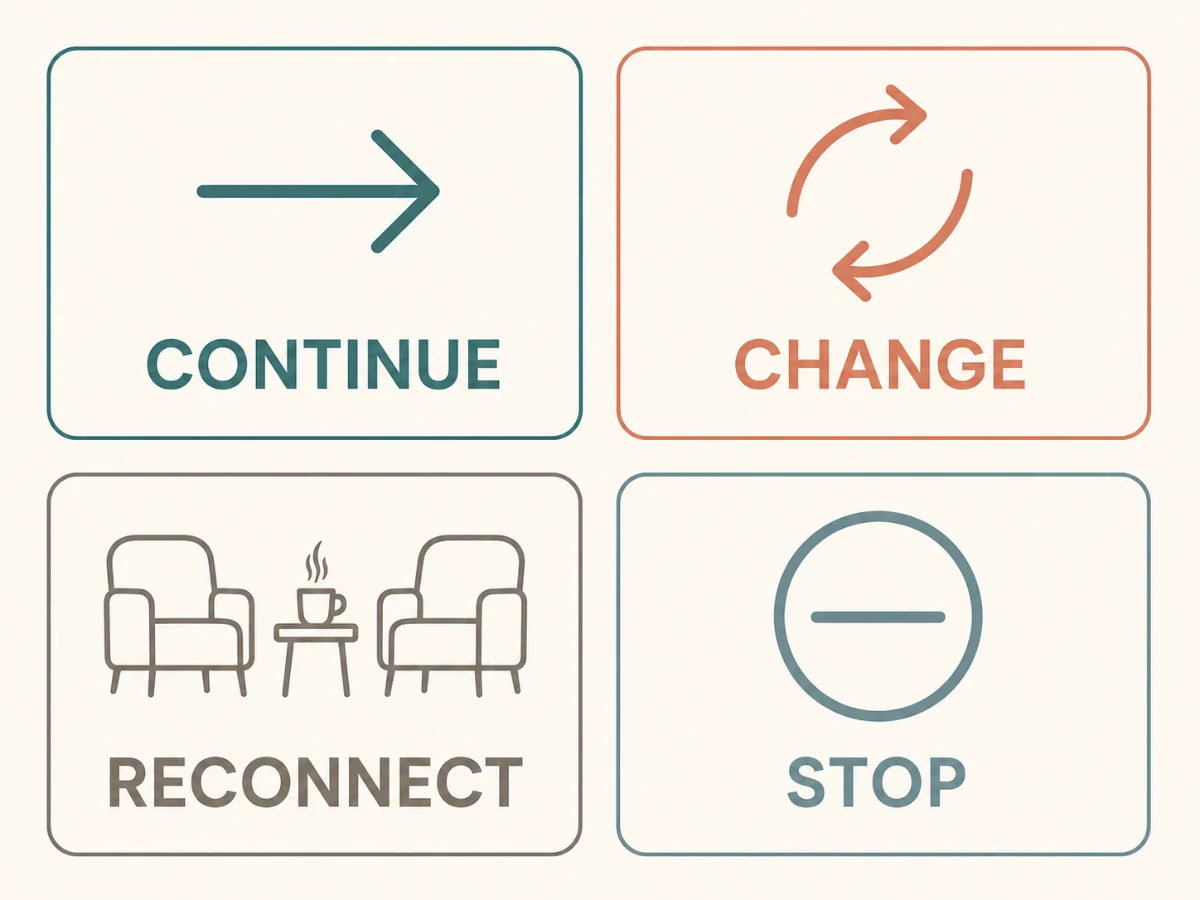
Gardez chaque étape suivante réellement disponible
Un check-in n’est pas neutre si « continuer » est la seule réponse qui sera la bienvenue. Proposer des choix de poids égal:
- Continuer: seulement après un clair, actuel, choix sans pression sur la prochaine étape spécifique.
- Changement: ajuster la position, rythme, paramètre, ou activité si tout le monde veut le changement.
- Reconnecter: parler, partager l'eau, s'asseoir à proximité, ou choisir un autre type de proximité sans la considérer comme une voie de retour à l'activité sexuelle.
- Arrêt: mettre fin à l'activité sans punition, négociation, ou une obligation d'expliquer.
Les partenaires peuvent vouloir des choses différentes après la même pause. Le but n’est pas de trouver un compromis qui maintiendrait le plan initial en vie.. C’est choisir seulement une option que chacun accepte librement. Le même principe s'applique lorsque les partenaires ont différentes préférences d'intimité: aucune réponse partagée n'est meilleure qu'une réponse qui demande à une personne de franchir une frontière.
Réalisez une réinitialisation pratique sans créer d’obligation
Une aide pratique peut faciliter une pause: apporter de l'eau, déplacer un oreiller, régler la lumière, offrir une serviette, faire taire un téléphone, ou donner de la place à la personne. Demandez avant d'aider plutôt que de supposer ce qui vous apportera un soutien. "L'eau aiderait-elle?" laisse plus de choix que de se tenir devant quelqu'un avec une liste de correctifs.
Gardez la réinitialisation séparée de la décision de reprendre. Être à l'aise, accepter un verre, se tenir la main, ou rester dans la même pièce ne crée pas de consentement pour plus de contact. Une personne peut apprécier les soins et quand même choisir de s'arrêter pour la journée.

Quand ne pas redémarrer
Ne redémarrez pas lorsque quelqu'un est incertain, silencieux, congelé, craintif, affligé, considérablement altéré, ou incapable de faire un choix clair. Arrêtez-vous si une limite a été franchie, si une demande est en débat, ou si une personne continue de demander après que l'autre a refusé. La poursuite immédiate n’est jamais requise pour prouver l’attirance, confiance, pardon, ou connexion.
La douleur change aussi la décision. Ne forcez pas et n'utilisez pas une activité différente pour tester si la douleur va disparaître. Conseils de l'ACOG sur les relations sexuelles douloureuses conseille de consulter un gynécologue ou un autre professionnel de la santé en cas de douleur fréquente ou intense. C'est ici aussi une limite conservatrice: arrêter l'activité et rechercher des soins individualisés lorsque les douleurs sont fréquentes, grave, ou autrement concernant.
Questions fréquemment posées
Dois-je expliquer pourquoi je veux faire une pause?
Non. Une brève explication peut être utile si vous souhaitez en donner une, mais la pause ne dépend pas du fait de persuader une autre personne que votre raison est suffisante. "Je dois m'arrêter une minute" est assez clair.
Est-ce que faire une pause ruine l'ambiance?
Ça change le moment, mais le changement n'est pas la même chose que l'échec. Une pause respectueuse peut protéger le choix et faciliter une communication honnête. L'activité peut reprendre, changement, ou finir; aucun de ces résultats ne doit être traité comme une soirée gâchée.
Et si une personne veut continuer?
Ne continuez pas l’activité sexuelle à moins que tout le monde veuille clairement passer à l’étape suivante.. La déception peut être réelle sans qu’il incombe à l’autre personne de la résoudre par davantage de contact..
Pouvons-nous planifier un signal de pause à l'avance?
Oui. Un mot, signal de la main, ou taper peut être utile lorsque sa signification est discutée au préalable. Un signal ne remplace pas l’attention: arrêtez-vous lorsque vous remarquez une incertitude même si le signal prévu n'a pas été utilisé.
L'essentiel
À pause contact intime avec connexion intacte, sois clair, arrêter le mouvement, et gardez chaque étape suivante disponible. Répondre à une pause sans pression, offrir des soins pratiques uniquement lorsque cela est nécessaire, et ne font pas du redémarrage la mesure d'un bon résultat. La connexion peut sembler continue, changer de cap, partager le calme, parler plus tard, ou s'arrêtant respectueusement.