指用コンドーム vs. Disposable Gloves for Intimate Touch

Finger condoms vs gloves for intimate touch is mainly a question of coverage and verified product purpose: a finger condom covers one finger, while a disposable glove covers the fingers, palm, and wrist. Neither category is always the better or safer choice. Check the exact product’s intended use, 材料, サイズ, フィット, lubrication or additives, condition, and your partner’s comfort before deciding.

If the activity involves one finger and you want the rest of the hand uncovered, a single-finger barrier may match that narrow task. If several fingers or more of the hand may be involved, a full glove offers more physical coverage. Coverage is only one part of the decision, しかし. A product label and authoritative guidance matter more than assumptions based on the words “finger condom,” “finger cot,” or “disposable glove.”

Finger condoms vs gloves for intimate touch: the key difference

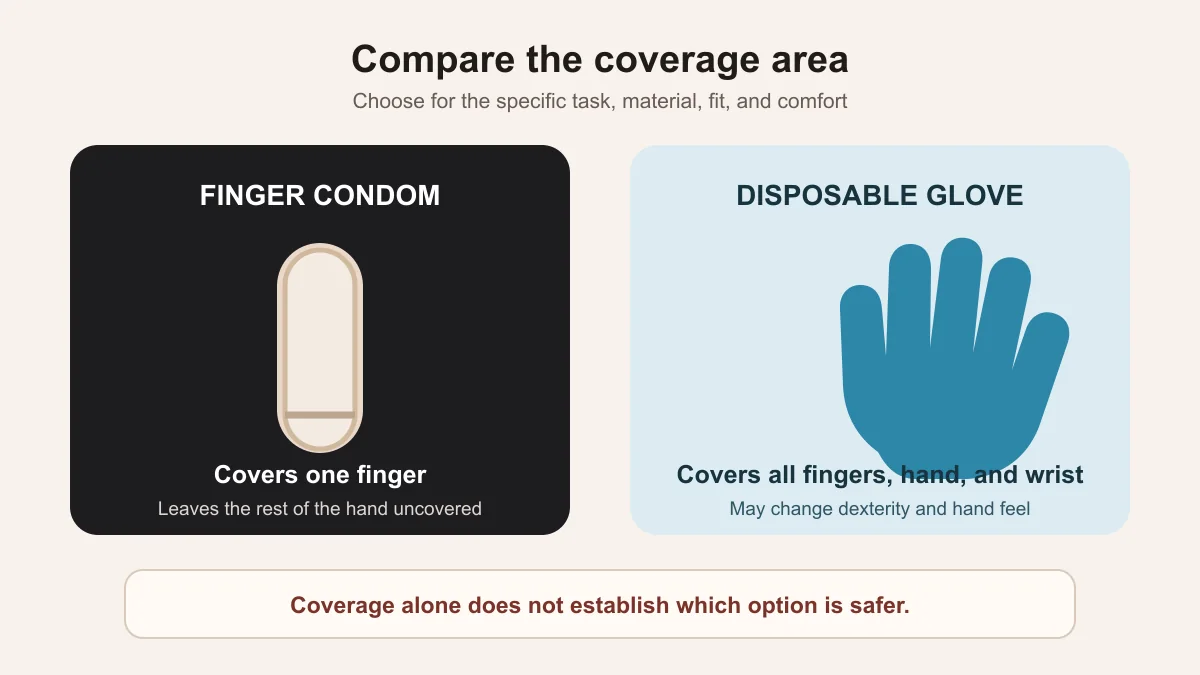
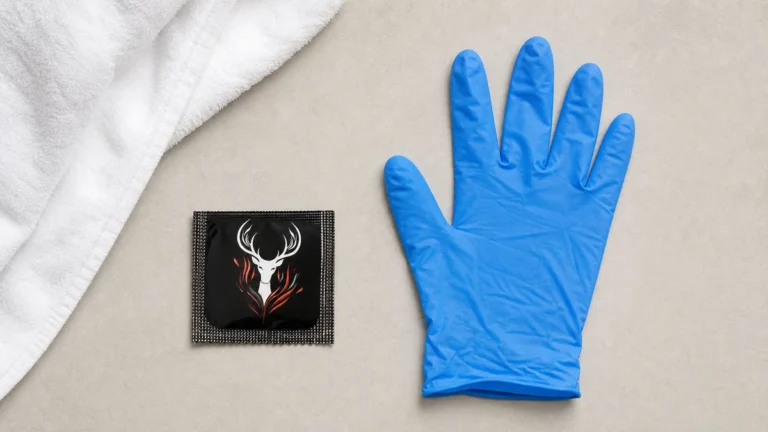
The most visible difference is simple. A finger condom is shaped to cover one finger. A disposable glove is shaped to cover the whole hand and usually extends to the wrist. Homerton University Hospital’s Open Doors sexual-health service describes finger cots as single-finger covers that may be useful when a whole glove is unnecessary.

Comparison graphic showing a finger condom covering one finger and a disposable glove covering the fingers, hand, and wrist
Coverage is the clearest physical difference, but coverage alone does not establish which option is safer.
Decision pointフィンガーコンドームDisposable glove
カバレッジOne fingerFingers, palm, back of hand, and wrist area
MovementLeaves uncovered fingers freeMoves as one full-hand barrier
材料Depends on the product; Callimis is verified natural latexVaries by product, including latex and synthetic materials
潤滑Depends on the product; Callimis is pre-lubricatedDo not assume personal lubricant is present or that additives suit intimate contact
使用目的Read the current label; Callimis is intended for adult intimate and personal hygiene useRead the current label; 医学, food-service, household, and industrial gloves can have different intended uses

This comparison describes form and verified facts, not relative effectiveness. Sexual-health educators include gloves among barrier options in some contexts. 例えば, Planned Parenthood’s safer-sex guidance mentions latex and nitrile gloves as ways to reduce contact with sexual fluids. That does not establish that every glove, or any specific finger condom, eliminates STI or infection risk.

Start with the product label, not a category assumption

“Disposable glove” is a broad description, not one verified specification. Some gloves are sold for medical examinations, others for food handling, cleaning, beauty services, or general household work. Their materials, additives, quality requirements, サイズ, and directions can differ. A box that merely says “disposable” should not be treated as automatic confirmation of suitability for intimate contact.

FDA の医療用手袋に関するガイダンス says medical-glove labels identify the material and advises users to check fit, replace torn gloves, and never wash or reuse them. Those statements apply to medical gloves. They do not turn a household or industrial glove into a medical device, and they do not prove suitability for a different use.

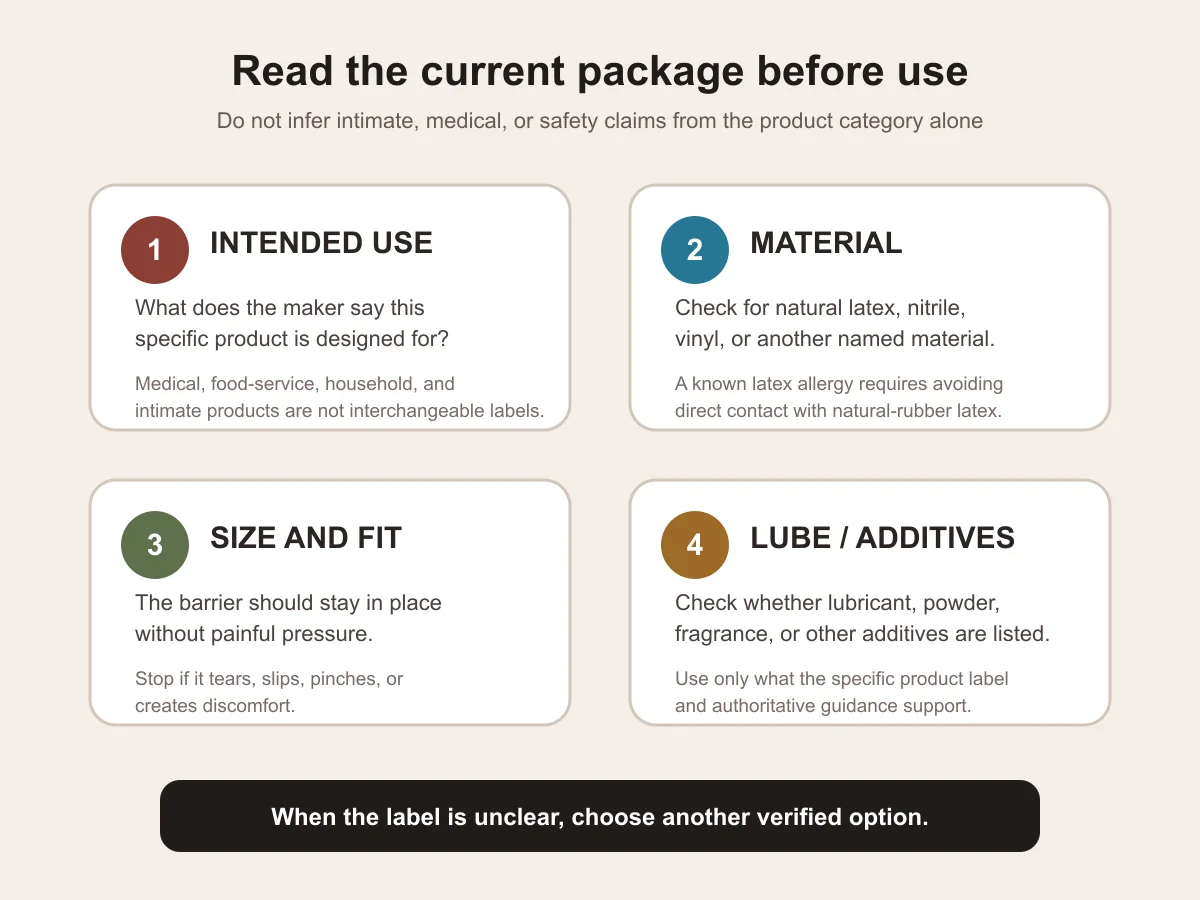
Checklist for reviewing intended use, 材料, size and fit, and lubrication or additives on a barrier package
The current package should identify the material and intended use; do not transfer claims from one product category to another.

Apply the same discipline to a finger condom. The verified Callimis facts identify a natural-latex, finger-shaped, pre-lubricated product intended for adult intimate and personal hygiene use. It uses a water-based, silicone-free lubricant and is a single-use disposable product. Those facts do not establish sterility, regulatory approval, clinical performance, or a guarantee of comfort or protection.

Compare coverage, movement, そしてフィットする

A single-finger barrier may make sense when only one finger needs coverage and the uncovered fingers should remain free for non-intimate tasks, コミュニケーション, or balance. A full glove may make more sense when the activity involves several fingers or the hand. The NHS, 例えば, advises latex gloves with water-based lubricant for vaginal or anal fisting, a context involving substantially more of the hand than one-finger touch.

More coverage is not automatically better for every situation. A full glove can change grip, 熱, hand feel, and fine movement. A finger condom leaves more skin uncovered, which may affect what contact occurs outside the covered finger. Decide which area actually needs a barrier, how many fingers will be involved, and whether the product remains where intended without painful pressure, bunching, or slipping.

Sharp nails, ジュエリー, and damaged packaging also deserve attention. FDA guidance warns that sharp objects can puncture medical gloves. It is reasonable to keep sharp items away from any thin barrier, but do not assume the two product categories have identical puncture resistance. Stop and replace the item if it tears, 滑る, or looks damaged; do not keep going merely because the interruption feels awkward.

Check the material and latex question

Material names matter. Callimis is verified as natural latex. Disposable gloves may be made from natural-rubber latex, ニトリル, vinyl, ポリウレタン, または別の素材, depending on the specific product. The internal guide to condom materials and formats can help with vocabulary, but its older claims should not replace the current package or an authoritative source.

CDC/NIOSH explains that natural-rubber-latex exposure can cause sensitivity or allergic reactions. If you have a known latex allergy, avoid direct contact with natural-latex products and ask an appropriate clinician about alternatives. Callimis should not be represented as suitable for someone with a latex allergy. A “non-latex” glove still needs its own material, additive, and intended-use review; the phrase alone is not a universal suitability guarantee.

Compare lubrication and additives

Callimis is verified as pre-lubricated with a water-based, シリコンフリーの潤滑剤. That is a product fact, not a promise that the amount will suit every person or activity. The existing pre-lubricated finger-condom guide provides product-use background, but the current package directions and verified project facts should control wherever older copy makes broader claims.

A disposable glove may have no personal lubricant. It may also have powder, 表面処理, colorants, or other additives depending on its category and label. Do not add an intimate lubricant until compatibility with that exact glove material and the lubricant is verified. Do not assume advice for external condoms transfers to every glove, and do not assume a smooth or powder-free surface means the product was designed for intimate contact.

What this comparison cannot prove

A category comparison cannot establish the performance of an unnamed product. A medical-examination glove has a regulated medical purpose, but FDA status for that glove does not create an intimate-use recommendation. 逆に, an adult intimate-hygiene product does not become a medical device because it is a barrier. The relevant claim must come from evidence for the exact product and exact use.

It is also inaccurate to convert physical coverage into a percentage of protection. A glove covers more skin on the hand, but uncovered skin-to-skin contact can still occur elsewhere. A finger condom covers less of the hand, but that narrower form may match a one-finger task. Neither observation supplies STI, infection, 妊娠, tear-resistance, or clinical-effectiveness data.

ついに, preference is not proof. One person may value full-hand coverage; another may prefer the movement of uncovered fingers. Those preferences matter for consent and comfort, but they do not verify material compatibility, allergy suitability, or product performance. Keep personal preference, label evidence, and health guidance as three separate parts of the decision.

A practical choice checklist

  1. Name the coverage area. One finger, several fingers, the palm, or the wrist?
  2. Read the intended use. Confirm what the maker says about that exact product instead of relying on the category name.
  3. Check the material. Look for natural latex, ニトリル, vinyl, or another named material and account for known allergies.
  4. Review lubrication and additives. Verify what is already on the product and what, if anything, is compatible with it.
  5. Check condition and fit. そのままの状態で使用する, in-date product when the label provides a date; stop if it tears, 滑る, pinches, or feels wrong.
  6. Agree on the plan. Ask what coverage and sensation your partner prefers, and make pausing or switching easy.
  7. Use a new barrier when needed. Follow the product directions and change barriers when switching between people or body areas rather than moving residue from one place to another.
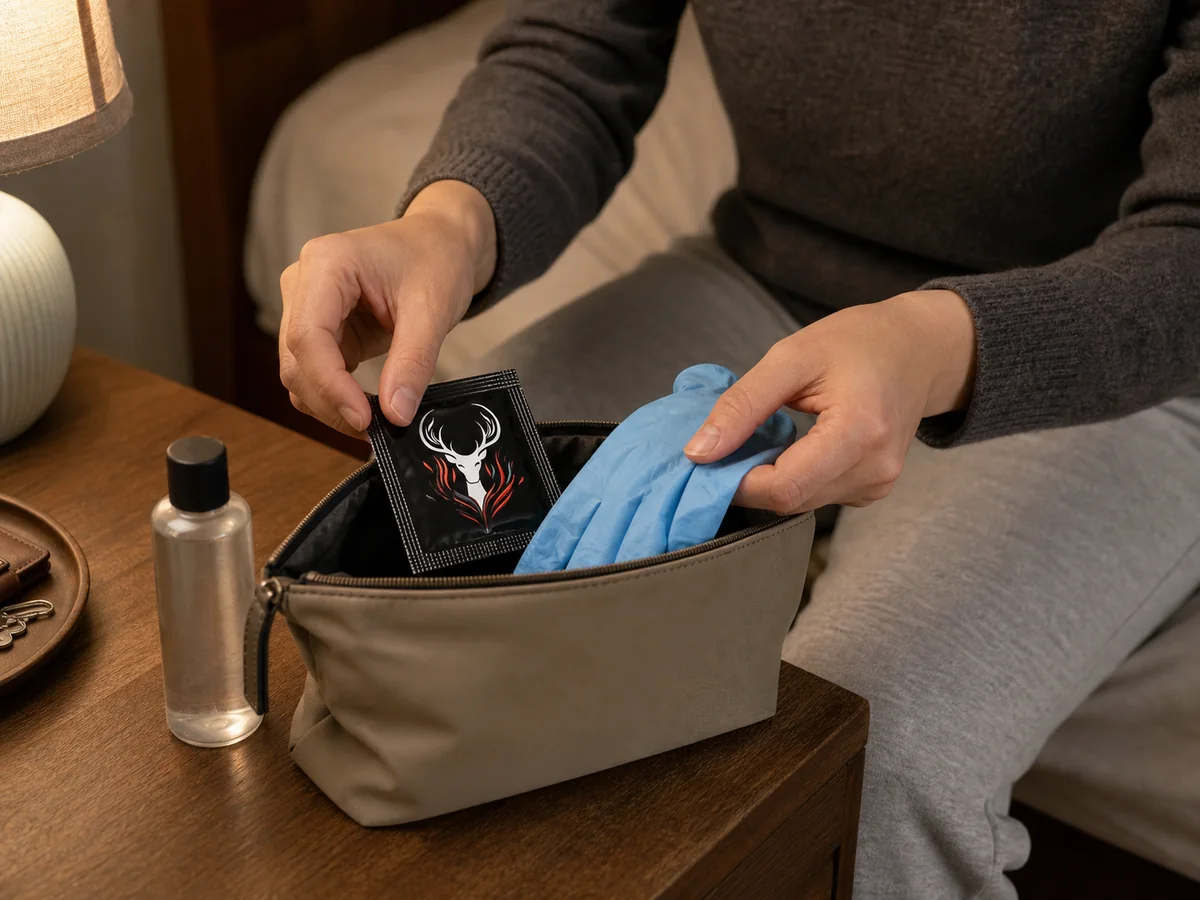
Fully clothed adult placing a sealed black finger condom packet and an unbranded blue glove into a personal-care pouch
Choose the option whose verified label, coverage, 材料, フィット, and preparation match the specific situation.

The checklist is meant to slow down assumptions, not make preparation clinical. A simple conversation such as “Would you prefer one-finger coverage or a full glove?” can identify the practical need without implying that either choice is mandatory. Consent and comfort can change at any time.

Single-use handling and cleanup

Wash and dry hands before handling the barrier. Inspect the wrapper or glove and follow the current directions. If a disposable item tears, 滑る, or becomes contaminated, stop and replace it. After removal, wash your hands again. The FDA specifically says medical gloves should never be washed, disinfected, shared, or reused; for other disposable gloves, follow the exact label rather than assuming identical instructions.

カリミスは使い捨てであることが確認されています. 使用後, place it in regular household waste and do not flush it. The broader overview of intimate barrier formats can help distinguish other categories, but each product still needs its own current instructions.

Frequently asked questions

Are finger condoms the same as disposable gloves?

いいえ. A finger condom covers one finger, while a disposable glove covers the whole hand and wrist area. Their materials, additives, ラベル, intended uses, フィット, and quality requirements can also differ.

Can any disposable glove be used for intimate touch?

Do not assume so from the word “disposable.” Sexual-health guidance mentions latex or nitrile gloves in some contexts, but you still need to check the exact glove’s material, 使用目的, additives, サイズ, condition, and compatibility with any lubricant. When the label is unclear, choose another verified option.

Does a full glove provide more coverage?

はい, physically: it covers the fingers, hand, and wrist area, while a finger condom covers one finger. More coverage does not by itself prove greater safety, suitability, 快適, or effectiveness for a particular intimate activity.

Can someone with a latex allergy use Callimis?

Callimis is made from natural latex and is not represented as suitable for people with latex allergies. Someone with a known latex allergy should avoid direct contact with natural-latex products and seek individualized advice from an appropriate clinician.

The bottom line

When comparing finger condoms vs gloves for intimate touch, begin with the area you want to cover, 次に、使用目的を確認します, 材料, フィット, lubrication or additives, product condition, and partner comfort. A finger condom is the narrower one-finger option; a disposable glove is the broader full-hand option. Neither label is a shortcut to a universal safety conclusion.

コメントを残す

カートに商品が追加されました.
0 アイテム - $0.00