
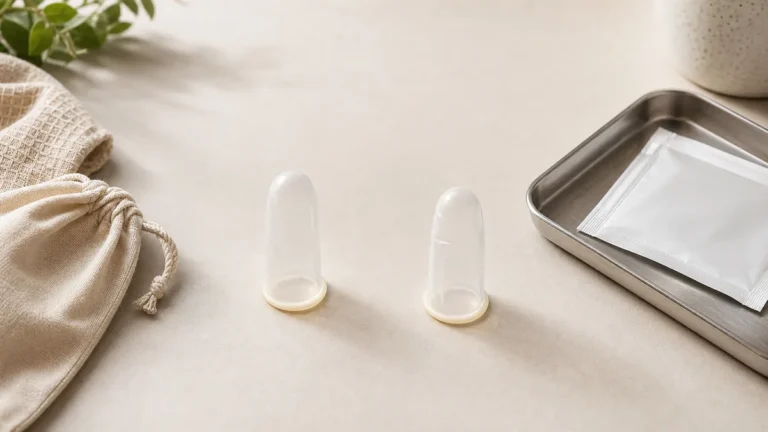
Finger condoms vs medical finger cots are best compared by intended use and labeling, not by shape alone. Callimis finger condoms are verified for adult intimate and personal hygiene use, while U.S. regulations place a medical finger cot in a patient-examination-glove category intended for medical purposes. Products from the two categories should not be treated as automatically interchangeable.
The terminology can be confusing because sellers and consumers may use “finger cot,” “finger cover,” and “finger condom” for items that look similar. Appearance does not prove what a specific product was designed, labeled, or regulated to do. If you are new to the intimate-use format, start with this overview of basic finger-condom use, then return to the label-first comparison below.
Finger Condoms vs Medical Finger Cots: The Short Answer
A Callimis finger condom is an adult intimate and personal hygiene product. The current verified fact file says it is finger-shaped, made from natural latex, approximately 0.03 mm thin, pre-lubricated with a water-based and silicone-free lubricant, and intended for one use.
A medical finger cot has a different documented context in the United States. 21 CFR 880.6250 identifies a non-powdered patient examination glove as a disposable medical-purpose device worn on an examiner’s hand or finger to prevent contamination between patient and examiner. The regulation classifies the device as Class I and provides a premarket-notification exemption when the device is a finger cot, subject to the regulation’s limitations.
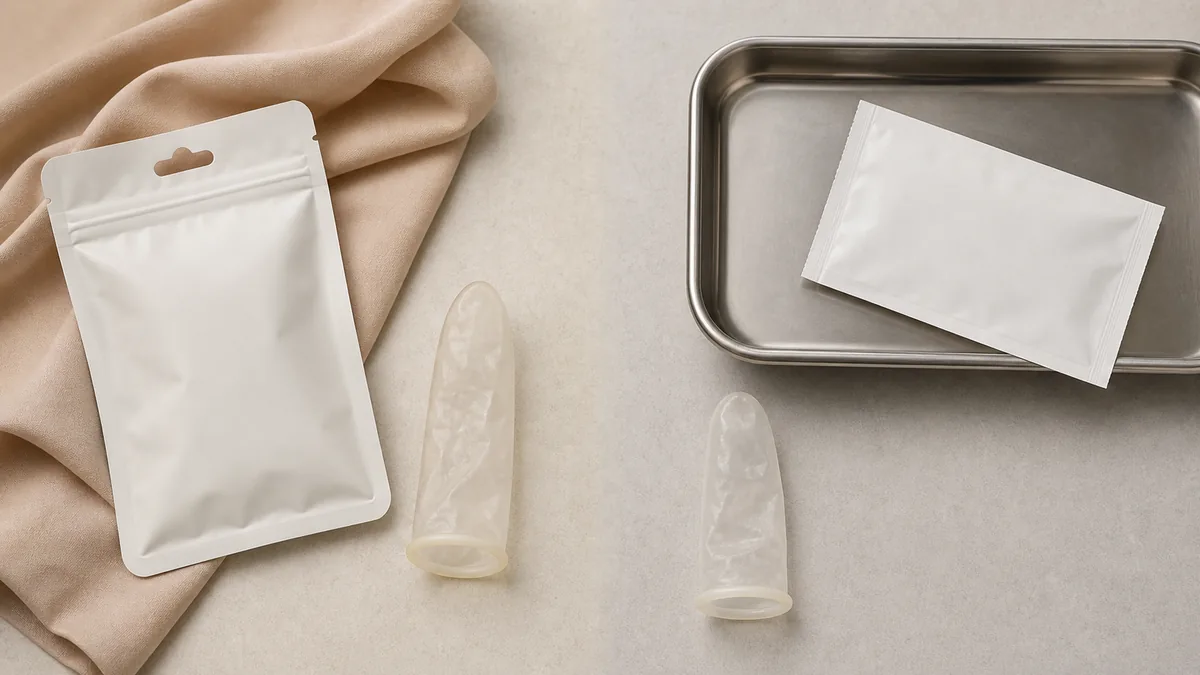
A Verified Side-by-Side Comparison
| Question | Callimis finger condoms | Medical finger cots |
|---|---|---|
| Verified intended use | Adult intimate and personal hygiene use | Medical-purpose use within the examination-glove definition in 21 CFR 880.6250 |
| Verified U.S. classification | No medical-device classification is verified in the project | FDA product code LZB, Class I, regulation 880.6250, 510(k) exempt subject to limitations |
| Verified material | Natural latex | Check the exact product label; this article does not assume one material for every medical finger cot |
| Verified lubrication | Pre-lubricated with water-based, silicone-free lubricant | Check the exact label; no category-wide lubrication claim is made here |
| Single-use status | Verified single-use disposable product | The federal definition describes a disposable device; follow the exact package directions |
| Sterility | Not verified; do not describe as sterile | Do not assume; use only an explicit product-level label statement |
| Medical-grade or FDA-approved claim | Not verified; do not make either claim | Classification or listing does not by itself mean a specific item is FDA approved |
The FDA’s LZB finger-cot classification record confirms the specific category details: device name finger cot, Class I, regulation 880.6250, and 510(k)-exempt status. That database record explains the category; it does not establish that every product called a finger cot belongs in it.
Why Intended Use Matters More Than the Nickname
Intended use tells you the context the manufacturer is representing. A personal-care product may have features chosen for intimate use, while a medical device label is tied to a defined medical purpose and regulatory category. The fact that both products cover one finger does not erase those differences.
This distinction also prevents two opposite mistakes. First, an intimate-use product should not be presented as a clinical examination device without evidence. Second, a product sold for a medical purpose should not be assumed to include intimacy-specific features such as lubrication, a particular thickness, or directions for intimate use unless its own label says so.
For Callimis specifically, the verified facts support an intimate and personal hygiene description. They do not support claims that the product is sterile, medical-grade, FDA approved, clinically tested, or intended to treat or prevent a condition. The Callimis pre-lubricated finger-condom guide provides broader use context, but this comparison uses only the narrower facts approved in the project fact file.
What to Check on the Package
Read the exact package before choosing either type. Do not fill in missing information from a marketplace title, a product photo, or another brand’s listing.
- Intended use: Look for a clear statement describing the task or setting the product is intended for.
- Material: Confirm latex or another named material on the package. The FDA’s medical-glove guidance says manufacturers must identify medical-glove materials on package labeling.
- Directions and limitations: Follow the exact instructions for putting it on, replacing it, and removing it.
- Single-use language: Do not assume a thin finger sleeve can be washed or reused. Callimis is verified as single-use, and FDA describes medical gloves as disposable.
- Sterile or nonsterile statement: Treat sterility as unknown unless the package explicitly states it.
- Lubrication: Callimis is verified as pre-lubricated. Do not assume another finger cot is lubricated or compatible with a particular added product.
- Regulatory wording: Verify any medical-device statement through an official database rather than relying on a badge or seller-created certificate.

The project contains a verified official Callimis packaging photograph documented in product-assets.md, but no complete label transcription. This article therefore does not quote wrapper text, describe package symbols, or claim a printed regulatory status. Package-related statements in this article have been checked against the official photograph and the approved product-fact file.
“FDA Registered” Is Not the Same as “FDA Approved”
Regulatory language is easy to overstate. FDA’s consumer guidance on device registration and approval says that establishment registration and device listing do not themselves mean approval, clearance, or authorization. FDA also says it does not issue device registration certificates.
For the LZB category, the official classification page says Class I and 510(k) exempt, subject to limitations. That is different from saying that every retail package using the words “medical finger cot” has been individually approved. A buyer should match the manufacturer, device name, and official record instead of treating a logo or generic database screenshot as proof.
Do Not Treat the Products as Automatically Interchangeable
If the task is adult intimate or personal hygiene use, choose a product whose verified intended use covers that context and follow its directions. If the task is a medical examination or another clinical activity, follow the health care facility’s instructions and use the product specified for that task. This article does not recommend substituting a Callimis finger condom for a medical device.
The same boundary works in reverse. A medical classification does not prove that a product has intimacy-specific lubrication, dimensions, comfort features, or directions. It also does not make every medical finger cot suitable for every person or every activity. Check the material and directions on the exact package instead of relying on the category name.
A Simple Buyer Decision Process
- Name the actual task before shopping.
- Read the manufacturer’s intended-use statement.
- Confirm material, lubrication, sterility statement, and single-use directions.
- Verify medical-device claims in an official database.
- Reject unsupported words such as “medical-grade,” “FDA certified,” or “FDA approved” when the evidence does not match.
- Keep the package until you have finished using the product so directions and material information remain available.
- Store intimate-use packages according to their directions; this guide to storing sealed finger-condom packages covers the related care basics.
Frequently Asked Questions
Are finger condoms and finger cots the same shape?
They can both be finger-shaped sleeves, but shape alone does not establish intended use, material, lubrication, sterility, or regulatory status. Compare the exact labels.
Are medical finger cots FDA approved?
That wording is too broad. FDA identifies finger cot product code LZB as a Class I device under regulation 880.6250 and lists it as 510(k) exempt subject to limitations. Registration or listing alone is not approval of every specific product.
Are Callimis finger condoms sterile or medical-grade?
Those claims are not verified in the project product-fact file, so the answer should not be assumed. Callimis is documented here only as a natural-latex, pre-lubricated, single-use product intended for adult intimate and personal hygiene use.
Can I use a medical finger cot for intimacy?
Do not decide from the name alone. Check whether the manufacturer’s intended use and directions cover the activity, and do not assume lubrication, comfort features, or compatibility that are not stated.
Can I use an intimate finger condom for a medical task?
Do not substitute it for a medical product without evidence and appropriate professional or facility guidance. Callimis is not documented in this project as a medical device.
The practical difference in finger condoms vs medical finger cots is not a nickname or silhouette. It is the documented intended use, label, directions, and regulatory context of the exact product. Choose from verified information, keep the two use contexts clear, and leave any unverified packaging or medical claim out of the decision.