
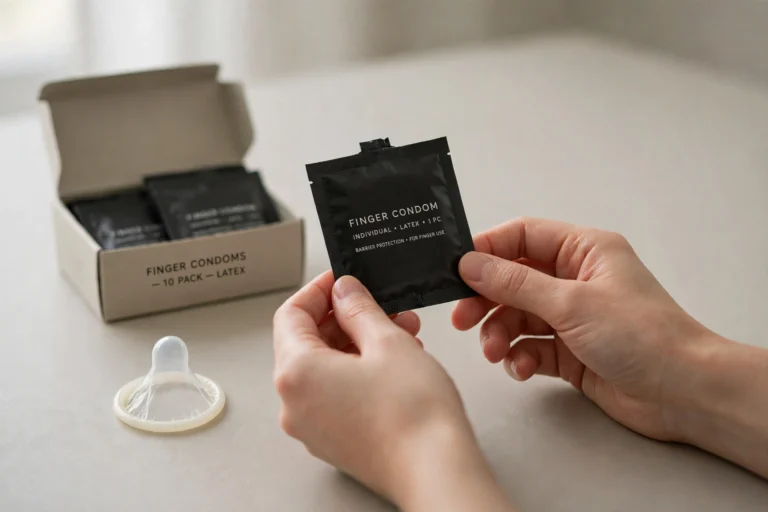
Do finger condoms prevent STIs? A finger condom covers one finger during manual touch. It can reduce direct skin-to-skin contact on that finger, but it does not guarantee protection against sexually transmitted infections, and it does not make a particular touch safe on its own. That is the short answer to whether finger condoms prevent STIs, and the rest of this guide explains where that limit comes from.
That limit matters because the question usually comes up in a practical moment. Someone is about to use a barrier and wants to know what it actually does. A finger-shaped cover is a barrier for one finger. It is not a test, a treatment, or a substitute for the other steps people use to lower risk.
Comience con lo que realmente está verificado
Callimis pre-lubricated finger condoms are made from natural latex, usar una forma en forma de dedo, y vienen prelubricados con una base de agua., lubricante sin silicona. son de un solo uso.
Those are the product facts in the editorial record for this site. The record does not include a tested claim about whether finger condoms prevent STIs for this exact product, una promesa de ajuste universal, or a complete instruction transcript. If the directions on your current packet differ from a general guide, the packet controls.
A photo can show the transparent material and the rolled base. It cannot show how the same item will behave on your finger, or what it will or will not block during a specific touch. Use the appearance as context, then judge the fit and condition on your own hand.
What a Finger Condom Covers, and What It Does Not
Paternidad Planificada describes a finger cot as a small latex cover that rolls over one finger. That one-finger form sets the scope. The cover sits on the finger that will make contact. Skin that is not under the cover is not under the cover.
En la práctica, that means three things.
Primero, the covered finger has a layer between it and the other person. An uncovered finger, a palm, a wrist, or another part of the hand does not. This is the first limit on whether finger condoms prevent STIs: only the covered finger has that layer.
Segundo, a barrier that is torn, rolled back, slipped off, or moved to another finger after use is no longer doing the job it was put on to do. If it comes off or looks damaged, stop and replace it with a fresh, sealed unit before continuing.
Third, a finger condom is meant for one finger and one use. Do not stack two on the same finger, transfer a used unit to another finger, or wash and reuse one. If two fingers will make contact, read the guide on whether to use one finger condom or more than one before opening any units.
What General Barrier Guidance Adds
El CDC guidance for dental dams follows the same pattern in a broader sense. Use a new barrier each time, leer el paquete, comprobar si hay roturas o defectos, and keep the barrier in place until finished. Those instructions cover dental dams, not this exact finger condom, so they are general barrier guidance rather than product-specific proof.
| Pregunta | What to keep in mind |
|---|---|
| Does one finger condom cover the whole hand? | No. It covers one finger. |
| Does it cover a second finger? | No. A second active finger needs its own unit. |
| Can it be reused? | No. It is single-use. |
| Does it remove all STI risk? | No. It can reduce contact on the covered finger, but it does not eliminate risk. |
| What decides the details? | The directions on your current packet, and the condition of the unit in hand. |

Do Finger Condoms Prevent STIs Completely? Why the Answer Is Not a Simple Yes
STIs can spread in more than one way: through skin-to-skin contact, through fluids, or without any symptoms at all. A single-finger barrier addresses only part of that picture, and only for the area it covers. That is why asking do finger condoms prevent STIs does not have a yes-or-no answer that holds for every situation.
That is why health agencies talk about barriers as one part of a wider approach, rather than as a standalone guarantee. Testing, talking with a partner about recent history and symptoms, and getting care when something feels off are separate steps. A finger condom does not replace them. El CDC page on STI risk and oral sex makes a similar point for oral contact: risk depends on the activity and the contact involved, not on a single product.
It also helps to be clear about what is not known here. This guide does not cite a study that tested this exact product for STI prevention. It does not claim a specific reduction in risk. If you need a risk assessment for your own situation, a clinician can give advice based on the activity, the people involved, and any symptoms or test results.
A Short Check Before You Use One
The check takes less than a minute. It is about the unit in hand, not about proving the product in general.
Choose the finger you plan to use before opening the packet. That avoids moving a single-use item from one finger to another. The guide on which finger should wear a finger condom walks through that choice in more detail.
Open the packet carefully. Mantenga las uñas afiladas, joyas, dientes, y herramientas alejadas del látex. If the wrapper is torn, abierto, manchado, or past its date, do not use that unit.
Enróllalo sin forzarlo.. Deténgase si no se desenrolla con suavidad., movimiento controlado. Do not pull hard or keep trying with an item that may have been caught or damaged.
Mira todo el dedo. Observe una agrupación importante, retortijón, or a base that rolls back right away. A single small wrinkle is not a sizing diagnosis, but repeated rolling or visible uncertainty is a reason to pause. For a fuller routine, ver how to check finger condom fit before intimate use.
Doblar y enderezar suavemente. Haz un puño flojo, then straighten the hand. Observe si el producto permanece en su lugar sin ajustes repetidos.

Check how it feels before contact. Pinching, palpitante, entumecimiento, estremecimiento, or pain is enough reason to stop. Do not try to get used to a feeling that hurts.
If the plan changes and a different finger will make contact, use a fresh unit for that finger. Keep spares sealed until they are needed.
When to Stop and Reassess
Stop if the finger condom breaks, se desliza, or rolls back during use; if you notice a tear, a hole, or a change in how it feels; or if either person feels uncertain or uncomfortable.
A pause does not have to end the moment. It can be a short check-in, a fresh unit, or a decision to change the plan. The separate guide on what to do if a finger condom breaks or slips off covers those steps in detail, and the fit guide linked above covers the pre-use check. Those steps are practical, not a promise that a replacement will fix every problem, and they do not change the basic question of whether finger condoms prevent STIs on their own.
If there was contact after a barrier failed, and you are worried about exposure, consider speaking to a clinician promptly. This guide cannot assess that risk for you. It can only describe the general limits of a one-finger barrier.
How This Fits With Other Barriers
A finger condom and a dental dam are not interchangeable: the dam is a flat sheet for oral contact, while the finger condom is a sleeve for one finger during manual touch. Choosing the wrong shape leaves the intended contact area uncovered. The comparison in dental dams vs. condones para los dedos explains that shape difference in more detail.

Lubricant choice matters in the same way. Callimis finger condoms are natural latex and already pre-lubricated. Si quieres un deslizamiento extra, choose a personal lubricant whose label says it is compatible with natural latex, and follow both labels. Oil-based products can weaken latex. That warning comes from general latex-condom guidance, including the FDA labeling for natural rubber latex condoms, and it applies here because the product is verified as natural latex. For the full compatibility rundown, ver can you use lube with finger condoms.
Storage matters too. Keep sealed units in a cool, lugar seco, away from heat, objetos afilados, and pressure that could damage the wrapper. Check the date before opening. The guide on how to store finger condoms properly covers those checks in more detail.
Products Mentioned in This Guide
The products below are the ones this guide refers to. Check the product page for the current price, contar, and package directions before ordering.

Callimis Preservativos para Dedos con Lubricación, 12 contar
látex natural, en forma de dedo, de un solo uso, prelubricado con una base de agua, lubricante sin silicona. $14.99 as listed on the site.
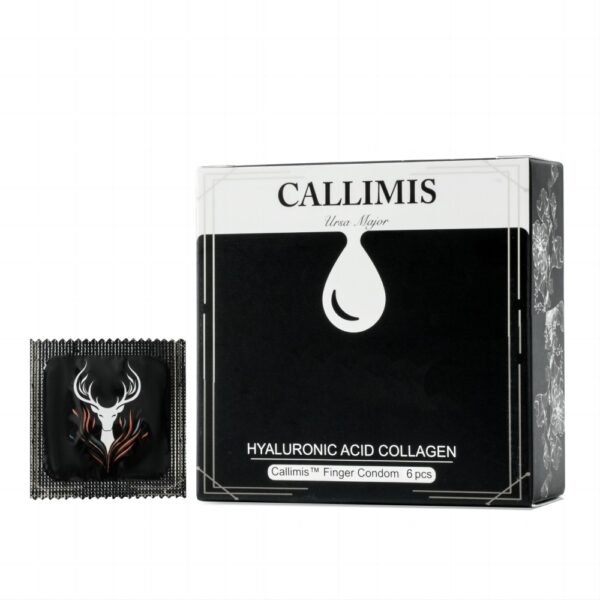
Callimis Preservativos para Dedos con Lubricación, 6 contar
The same finger-shaped, single-use format in a smaller count, useful for trying the product or keeping spares sealed. $7.99 as listed on the site.

Dique dental ultrafino para uso oral, 6 contar
A flat sheet barrier for oral contact, the other format discussed in this guide. $9.99 as listed on the site.
Use a finger condom for what it is: a single-use, finger-shaped barrier for one finger during manual touch. It can reduce direct contact on that finger. It does not cover the rest of the hand, it does not cover a second finger, and it does not guarantee protection against STIs. So do finger condoms prevent STIs? Not completely, and not on their own. They can reduce contact on the covered finger, and that is the limit to plan around.
Choose the active finger first, check the wrapper and the fit, keep the unit in place, and replace it if it fails. If you want advice about your own risk, talk to a clinician. If the packet says something different from this guide, sigue el paquete.
This article is general information, no consejo medico. It relies only on the product facts in the site’s editorial record and on general barrier guidance from public health sources. It does not claim that this product prevents STIs.